- This event has passed.
A Revolution Will Not Be Tweeted
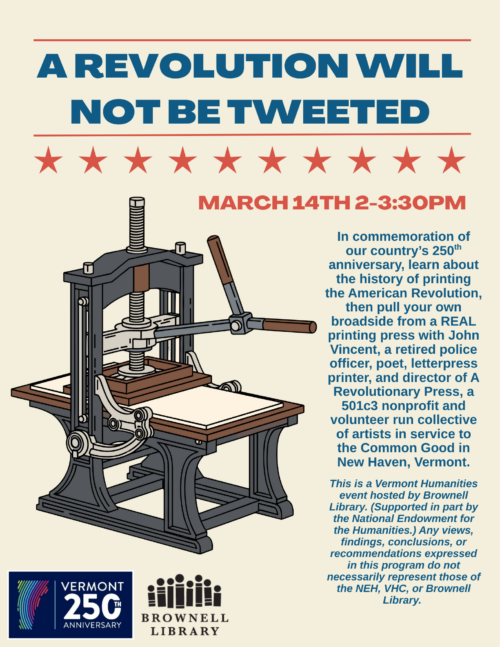
“We The People” are invited to this presentation to learn the history of printing The American Revolution, and to engage in a conversation around an old printing press, pull a broadside, and imagine what The Next Revolution could be.
When the hand written Declaration of Independence was delivered to the local print shop the evening of July 4, 1776, it was “massed produced” on the printing press over night. But only after it was entirely set by hand, one l-e-t-t-e-r at a time and locked up in a press bed to be pulled by hand, one copy at a time.
Similar to the deliberate and intentional methodologies which the earlier revolutionaries employed to foment and print their Revolution of 1776, are those utilized contemporarily at A Revolutionary Press, the print shop in New Haven, Vermont.
At this presentation you will learn that the mission statement of A Revolutionary Press, inspired by the Declaration of Independence, directs us in our efforts to bring about an entirely distinct Revolution for the present and the future, as we listen to, and print some of today’s lesser known radical and revolutionary visionaries. Everyone at this event will have the opportunity to print one of these pieces to help imagine that next Revolution.
This event is best for youth in grades 5+ and adults.
About the presenter:
John Vincent is a retired police officer, poet, letterpress printer, and director of A Revolutionary Press, a 501c3 nonprofit and volunteer run collective of artists in service to the Common Good in New Haven, Vermont.
John is also the co-curator of “Finding Hope Within: Healing and Transformation Through the Making of Art Within the Carceral System”, a traveling art exhibition in Vermont for 2023-2026. He presents on the historical and contemporary significance of hand setting type on the printing press in context with the past and future Revolutions in this country. Learn more on his website.
This is a Vermont Humanities event hosted by Brownell Library. (Supported in part by the National Endowment for the Humanities. Any views, findings, conclusions, or recommendations expressed in this program do not necessarily represent those of the NEH, VHC, or Brownell Library.)