- This event has passed.
Vermont Astronomical Society Monthly Meeting
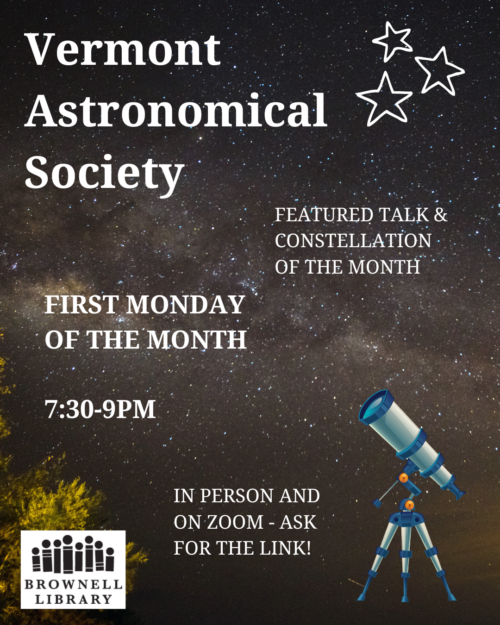
In-person and via Zoom
Ask for the Zoom link from paulwaav@together.net or theresamarie11@GMAIL.COM
Asteroids and Meteors
By Steve Grimsley
Asteroids and meteors are the leftovers of non gaseous material from the formation of the solar system. They are found throughout the solar system but are concentrated in the main asteroid belt between the orbits of Mars and Jupiter. Much of what we know about the early history of the solar system comes from the study of these rocky remnants that made their way to Earth.
There are three main categories of meteors, stony, stony iron, and iron. These types mostly are based on where, in an internally melted and gravity segregated asteroid, they were formed.
Stony meteors that contain chondrules are known as chondrites. Chondrules are spherical grains of silicate minerals 1 – 3 mm in size from rapidly cooled molten droplets in the primordial solar nebula. They are composed of pyroxene, olivine, plagioclase, glass, iron nickel, and sulfate minerals that have not undergone a full melt since their formation. Their bulk composition is nearly identical to the Sun without hydrogen and helium and other light volatile elements and compounds. A special class of stony meteors are the lighter carbonaceous chondrites. These make up a higher proportion of asteroid bodies further away from the Sun. The carbonaceous meteorites represent the most unaltered non-gaseous material in the original cloud from which our solar system formed. They date to 4.55 billion years, back to the earliest formation of the solar system. Ordinary stony chondrite meteors are by far the most common type.
Achondrites are stony material that has undergone a full melt, cooling in a differentiated asteroid. These meteors are much like igneous rocks that form on earth. Fragments from the moon and Mars that have fallen on Earth are achondrites.
Stony irons and irons are from the interiors of large asteroids whose interiors melted and gravity segregated. Meteors of this type have been some of the largest that have finds. Polished surfaces of these have much visual appeal.
Following the main presentation, our recurring monthly presentations will include Constellation of the Month by Terri Zittritsch.